Ideas
Everything you need to know about garden window replacement
What is a garden window?
A classic garden window is a window that projects from the side of the home with glass on all sides, including the roof. The name garden window comes from the greenhouse-like functionality it provides, as it lets in ample natural light for plants. These windows are commonly found in kitchens where you can grow an herb garden or brighten up your space with flowers.
What’s the difference between a garden window and a bay window?
The most significant difference between a garden window and a bay window is that the latter has a roof instead of glass on top. While garden windows can come in a variety of configurations, most are similar to box bay windows, which have flanking windows at 90-degrees. This makes a box bay a good replacement option. Our box bay window has a picture window in the center and a casement window on either side.
Can I replace a garden window?
You can absolutely replace a garden window with a new bay window. Andersen doesn’t offer a garden window with glass on top due to the design’s reputation for leaking water through the top. However, one of our bay windows can be used in place of your current garden window. The best replacement option for a garden window is our 400 Series Bay Window in a box configuration with flanking windows at 90 degrees.
With our 400 Series Bay Window, mullion posts lock into a channel in each adjoining casement window for a sturdy unit. On the interior, the wood can be stained or painted in the factory or onsite (for a perfect match with your existing trim). You’ll select an exterior color when ordering, and you’ll never have to worry about repainting because the protective cladding is so durable.
We offer a variety of standard sizes, plus custom sizing to 1/8 inch.
Tips for replacing a garden window with a bay window
When replacing a garden window with a bay window, here are a few things you should take into consideration.
What’s the size of your rough opening?
The size and cost of your replacement configuration will depend on the size of your current window and whether the rough opening will need to be modified. Our bay windows are available in standard sizes. We also offer custom sizing to 1/8-inch.
What kind of siding do you have?
The type of siding your contractor will be working with makes a difference in a bay window installation project. Brick siding is more common in traditional homes and can be complicated and costly to modify, but replacement is still possible. If you have a type of siding that can be peeled back, such as vinyl, it will be easier and likely less costly to replace. No matter the scenario, you’ll want an experienced window and door contractor because bay window installation includes three combined windows in one unit, increasing the complexity of the project.
What style is your home?
If you have a garden window, you don’t have to replace it with a bay window. You may prefer a flat window instead. A picture window, an awning window, or even a flat window combination are just a few of the possibilities. It’s feasible to change the type of window with your replacement, but once again, we’d recommend hiring an experienced window and door installer.
We can help you find a local contractor for your garden window replacement project.
Alternate ways to create a garden window
If you want to grow an indoor garden but don't want to deal with a leaky garden window, there are still a variety of ways to design a similar effect.
Pass-Through Windows are scaled-down versions of our Big Doors, so they can fold, glide or open automatically. These windows are ideal for kitchens because they create large, clear openings for passing food and drinks to outdoor living spaces. Their size also lets in an abundance of natural light and fresh air for the perfect garden window substitute.
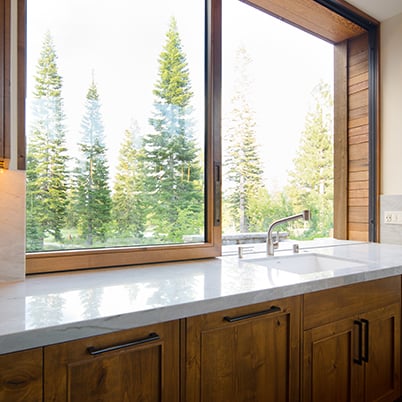
Twin casements, or two casement windows joined together, can fill an opening of any size while bringing in more light overall. Joining windows connects them without wall framing between, so there’s more glass. Casements are operated with a crank, which is always helpful when you’re reaching over a countertop or sink as you might be in a kitchen.

How do I replace a garden window?
Replacing a garden window with a bay requires good planning and thoughtful installation. Here are a few of the factors to be aware of when replacing a garden window with a bay window.
- A bay window is more exposed to the elements than other window styles, because it projects beyond the wall of a home. This means attention to flashing and insulation is extra important. Often extra insulation is added at the header and under the seat board.
- The weight of a bay window is significant because it’s a joined unit including three windows. This means extra people or equipment might be needed during installation.
- Homes with masonry or brick facades will require installation steps that go beyond what’s standard.
- There’s a lot of room for error when measuring, and the consequences of incorrect measuring could be a window that’s not the right size.
For all these reasons and more, the risks outweigh any cost savings benefit you might get from DIYing. The best way to make sure your new window performs as it was designed to is to hire a professional for your garden window replacement project.
If you’re a pro looking to install a 400 Series bay unit, check out our measurement guide, sizing chart, and installation guide.
Need help finding a qualified pro? Find a retailer in your area that offers installation services.
Are garden windows energy-efficient?
Our box bay windows, which are an excellent garden window replacement, are available with the same energy-efficient glass options as our other window styles. Keep these selections in mind to help boost the efficiency of your bay window:
- Low-emissivity (Low-E) coatings can help keep heating and air conditioning in your home and help reduce the impact of the outdoor temperature. The best type of glass coating will depend on the climate you're in and budget considerations.
- The style of window (or type, as we call it) can also make a difference. Fortunately, the windows used to make bay windows perform better. Picture windows are the most efficient simply because they don’t open, and casement windows are the most efficient operable window because of their seals and single-sash design.
- You can further boost efficiency with thoughtful choices, like skipping grilles, which can conduct energy transfer through your window. Keep in mind that the bigger you go, the less energy efficient the window will be, because glass is never as efficient as a wall.
Learn more about energy-efficient windows.
